A streamlined practice workflow depends on systems working together. The dental operatory relies on air and suction from the mechanical room. Dirty instruments must move through reprocessing before they’re ready for the next treatment. Cabinetry needs to properly fit and support equipment while complementing the clinical workflow. Throughout the clinical zone, these systems come together to support clinicians as they move from one patient and procedure to the next.
Yet equipment decisions are often made individually: a chair from one manufacturer, an X-ray unit from another, cabinetry from the local carpenter and a new sterilizer when the old one needs to be replaced. Each product may perform its job well. But assembling a practice one product at a time can overlook an important question: What could you gain by choosing equipment designed as part of one ecosystem?
Choosing solutions from one manufacturer creates an opportunity to integrate the practice on several levels. Physically, equipment and cabinetry can be designed to work together around the clinician, patient, and workflow. Design expertise can help translate those capabilities into a clinical environment planned around the way the team works. Digitally, connected technology can make equipment information and management more accessible. And throughout the life of the equipment, a more unified portfolio can simplify how practices access important product information.
For dental teams balancing busy schedules, staffing challenges, and patient expectations, reducing complexity across the clinical environment can be just as valuable as the performance of any one product.
Designing the Ecosystem Around the Workflow
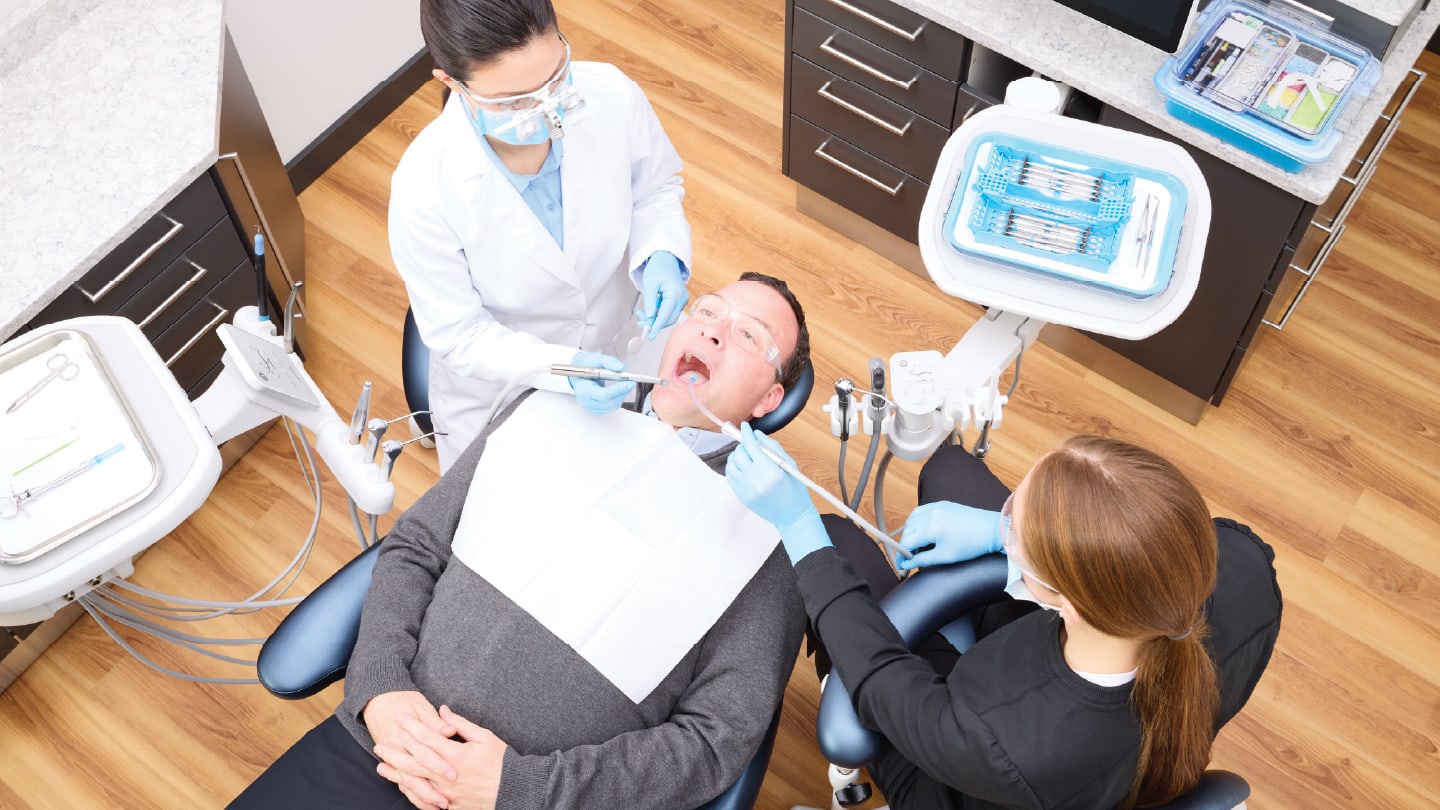
Creating an integrated environment starts well before equipment is installed. Consider the elements that come together around a single dental chair:
- The clinician and assistant need room to position themselves around the patient.
- The delivery system needs to keep instruments accessible without interfering with positioning.
- The light needs to provide visibility from different working positions.
- Stools need to support the clinical team in relation to the patient and surrounding equipment.
- Cabinetry needs to provide storage and work surfaces that help reduce reaching, twisting, or movement away from the treatment zone.
When each component is selected or planned independently, the clinical team may ultimately have to adapt to the environment around them. Considering the components together creates an opportunity to reverse that relationship and design the environment around the team.
Designing the environment around the clinical team means considering not only how individual products perform, but also how they work together within the larger clinical environment. Manufacturers such as Midmark offer coordinated operatory equipment, including dental chairs, delivery systems, lighting, stools, and cabinetry, as well as design services that can help practices consider workflow, equipment placement, and clinical space together.
Simply purchasing products from the same manufacturer does not automatically create an integrated practice. Those products still need to be thoughtfully planned and positioned within the space.
Making the Space Work Harder
Thinking about the clinical environment as a system can also create opportunities that might be missed when products are considered individually. A central station positioned between two operatories, for example, can support both spaces while conserving floor space. An intraoral x-ray unit, such as the Midmark Preva™, can be incorporated into this type of configuration so that one unit can serve two adjacent operatories.
Considering the x-ray as part of the larger clinical environment allows practices to think beyond where the equipment will fit to where it can best support the workflow.
The equipment itself can further support efficiency. Sag-free, drift-free positioning can help the x-ray tubehead remain where the clinician places it, reducing one potential contributor to positioning errors that can lead to retakes. In this context, the x-ray unit’s placement and performance are part of a larger strategy for keeping care moving between spaces and procedures.
Cabinetry can play a similar role. Side cabinetry can position frequently used supplies within easier reach of the clinical team, while central stations can support shared functions between treatment spaces. Because the cabinetry is considered alongside the chair, delivery system, stools, and other equipment, storage becomes part of the workflow rather than something simply added wherever space remains.
These are relatively simple examples, but they illustrate an important benefit of an ecosystem: the opportunity to think about the relationships between products in addition to the features of the products themselves.
Extending Integration Beyond the Operatory
The benefits of an integrated approach extend beyond the operatory. Instruments leaving an operatory enter a multistep reprocessing workflow before returning to patient care. The equipment performing each step matters, but so does the way the space supports movement from contaminated to clean.
Clinical-grade cabinetry can help establish that progression while providing appropriate locations for instrument processing equipment, supplies and storage. Equipment with automation can help simplify individual steps within the process. When the cabinetry, equipment and workflow are considered together, the sterilization center can function as a system rather than a collection of devices placed wherever they fit.
The same interconnected thinking extends to the mechanical room. Air compressors and vacuum systems may operate out of sight, but they support procedures throughout the practice. If drive air or suction is interrupted, the effect can quickly reach multiple operatories.
From treatment to instrument processing to the mechanical room, each area performs a different role. But from the perspective of keeping a practice running, no area operates entirely on its own.
Adding a Digital Layer to the Ecosystem
Today, integration can extend beyond how equipment physically works together.
Connected technology can add a digital layer to the ecosystem by making information about equipment easier to access and manage. Platforms such as Midmark Smart View™ can bring information from supported connected products into a centralized portal. Because a dental chair, air compressor, and vacuum perform different functions, the information available for each device differs as well. Depending on the product, practices can gain greater visibility into equipment status, maintenance information, and service history.
The value of connectivity is making useful information more accessible so practices can better understand and manage the products they rely on every day.
Greater access to equipment information can help practices move from reacting to issues toward more proactive equipment management. For a practice with multiple connected devices—or an organization managing equipment across multiple locations—that centralized view can become increasingly valuable.
Connectivity can also create value beyond installation day. Connected equipment can receive software updates, allowing functionality to evolve over time.
In that sense, the ecosystem can work together in two complementary ways: physically, through equipment and spaces designed around a common workflow, and digitally, through technology that helps practices better understand and manage that equipment over time.
Simplifying Equipment Management
There is another potential benefit to choosing more equipment from one manufacturer that may be less noticeable during a patient visit but valuable throughout the life of the equipment: simplicity.
Owning dental equipment involves more than using it. Practices need access to serial numbers, manuals, warranty information, technical documentation, and service history. When equipment comes from several manufacturers, that information may be distributed across different resources and systems.
A more unified equipment portfolio can help simplify that experience. Manufacturer portals, such as myMidmark, can provide practices with centralized access to information about registered equipment, including products without connectivity.
There can also be practical advantages to working with a manufacturer that understands the broader environment those products are designed to support. From planning the space to selecting equipment and managing products after installation, practices can approach the clinical environment as one ecosystem rather than a series of unrelated spaces and purchases.
More Than the Sum of Its Parts
Choosing an ecosystem from a single manufacturer doesn’t eliminate the need to carefully evaluate the performance, features, and fit of individual products. It does, however, add another consideration to the purchasing decision: How well will all this work together?
Can the chair, delivery system, light, stools, and cabinetry create a cohesive workspace around the clinician and patient? Can imaging equipment be positioned to efficiently support adjacent treatment spaces? Can the sterilization center be designed around the path instruments actually travel? Can design expertise help identify those opportunities before equipment is installed? And once the equipment is in place, can connected technology and centralized product information make it easier to manage?
Those benefits can be difficult to capture when comparing individual product specifications.
Manufacturers offering equipment across multiple areas of the dental practice can help bring those physical components together around the practice workflow, while connected technology can add another layer of integration once the equipment is in place.
Each product still needs to perform its individual job. The value of an ecosystem is what can happen beyond that—when equipment, space, technology and information are designed to work together. The goal isn’t simply to fill a dental practice with equipment. It’s to create a clinical environment designed to perform as a whole.
Figures and Images

Michael C. Couch, MBA, EDAC, LEED AP BD+C